In early 2021, a quiet studio named Game Science released a new look at Black Myth: Wukong, and for a few days the internet seemed to hold its breath. About a year had passed since the first reveal had shocked players around the world. This time, however, the team was not asking for faith. They were showing their work.
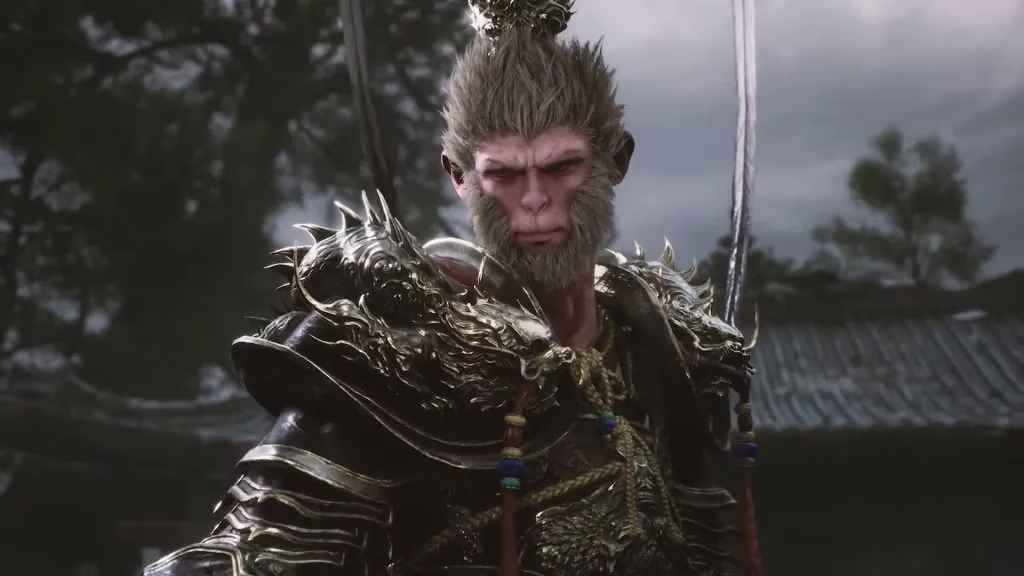
The new footage arrived as six minutes of in-game cutscenes and eight minutes of gameplay, all running with ray tracing and Nvidia DLSS enabled. What stood out immediately was not just the scale, but the density. This was not an empty tech demo polished with a few hero shots. It was a forest that seemed alive.
The showcase opened in a dense woodland that felt almost humid through the screen. Foliage swayed constantly, as if a real wind moved through the branches. Real-time lighting cut through the canopy and crawled across roots and stones. Shadows shifted naturally with the camera. Falling leaves drifted down one by one, catching the light in a way that made the scene feel less like a game environment and more like a place with its own weather.
Then the creatures arrived. One new enemy, bulky and strange, could trap the player with roots, punishing anyone who simply button-mashed their way forward. It was a small but important signal: combat in Black Myth: Wukong would demand attention, movement, and patience. After that came two bosses.
The first was a large foe that attacked with its head and thunderous claps. The sound design, even in compressed video, made every impact feel heavy. The second boss was a dragon crackling with electricity. Unlike the airborne dragons common in fantasy games, this one mostly stayed on the ground. It swiped with its claws, lunged across the arena, and whipped its tail in wide arcs. It moved like a predator, not a set piece.
Game Science also used the moment to confirm several details. Black Myth: Wukong was being developed on Unreal Engine 5, which explained the extraordinary lighting and environmental detail. The game would feature more than 100 different enemy types. It would offer at least 15 hours of playtime. Yet there was still no release window, and the console plan remained vague beyond the promise of “consoles and PC.”
That vagueness did not matter much at the time. What players saw in those fourteen combined minutes felt like a clear statement of intent. The developers were not chasing a trend. They were building a myth.
The demo also revealed a philosophy that would later define much of the project’s identity. Every enemy was not just a health bar. Every environment was not just a corridor. The forest, the roots, the thunderous claps, and the electric dragon all hinted at a world drawn from Chinese mythology, but reinterpreted through a modern action lens.
A handy snapshot of that 2021 showcase:
-
🎬 Six minutes of in-game cutscenes
-
🎮 Eight minutes of gameplay with ray tracing and DLSS
-
🌲 A living forest with moving foliage, real-time lighting, and falling leaves
-
👹 A new enemy that trapped players with roots
-
💀 Two bosses: a head-smashing brute and a ground-bound electric dragon
-
🧌 More than 100 enemy types promised
-
⏱️ At least 15 hours of playtime
-
🚀 No release window provided
Looking back from 2026, that forest demo has aged remarkably well. After many years of anticipation, Black Myth: Wukong eventually launched in August 2024 and became a global phenomenon, far surpassing the scale shown in those fourteen minutes. The same attention to movement, light, and myth was present in the final experience, and players who returned to the 2021 footage found that the promise had not been broken. If anything, the forest was only the beginning.
The legacy of that showcase is not just technical. It is emotional. It reminded players that a studio with something to prove could still stop the world with a simple walk through a dark, breathing forest. And in 2026, when people talk about the moments that built Black Myth: Wukong's legend, they often begin with the leaves falling through the trees while an electric dragon waited below.