The year is 2026, and the gaming landscape has been thoroughly pummeled, reshaped, and occasionally tenderized by the Soulslike genre. From indie darlings to triple-A behemoths, the DNA of relentless challenge is everywhere. Enter Game Science’s magnum opus, Black Myth: Wukong, a title that has spent years batting away the Soulslike label like a persistent mosquito. Yet, as the dust settles after its massive success, one design choice remains a fiery brand on the forehead of every player: there is only one difficulty setting, and it will absolutely drink your tears like a fine vintage wine.
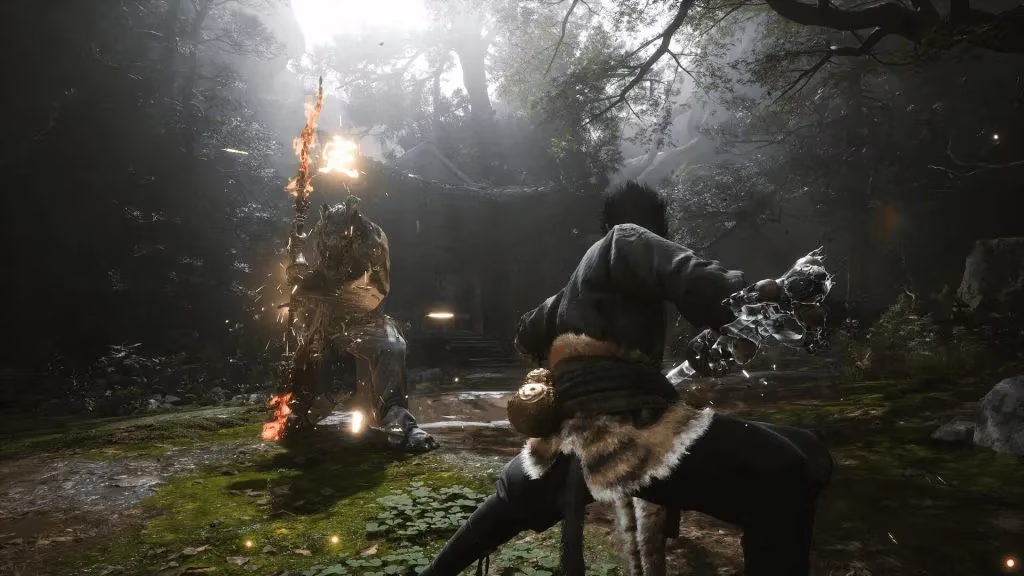
The studio’s philosophy, articulated before launch and now burned into the collective memory of millions, was brutally simple. Players step into the fur of the Destined One not to leisurely stroll through mythological China, but to fight like a hero. And a hero, in the eyes of Game Science, does not get to fumble through a menu slider asking for a "Story Mode" when a tiger-demon hybrid is using their spine as a toothpick. The difficulty knob is not missing; it was melted down and forged into the very soul of every boss encounter.
This approach acts less like a traditional video game feature and more like a cultural corset. One cannot loosen it when things get uncomfortable. Instead, the game tightens and relaxes organically across its sprawling chapters, creating a rhythm that mimics the unpredictable nature of legend. Some areas flow like a calligraphy brush on silk, a meditative dance of combos and transformation spells. Then, without warning, the path narrows into a crucible where a single blade of grass might as well be a guillotine.
Game Science confirmed early on that players could expect a landscape littered with trial and error, a phrase that sounds far too polite for what actually transpires.
"You can’t change the difficulty, but the difficulty doesn’t remain the same for the whole game. The philosophy is that players fight like a hero. When we were developing the game we had to make a lot of hard choices. The route we chose was to make the player have lots of tries so that after each battle they could think about what is the best combat method for this fight specifically."
This statement, handed down like ancient scripture, reveals the core loop. It is not just about memorizing attack patterns until your fingers bleed onto the controller. It is about forced enlightenment. After the fifteenth death to the same ethereal boss, the player’s brain does not just recognize the wind-up animation of a devastating sweep; it begins to weave a philosophical counter-tactic. Do you freeze the enemy mid-lunge with a specific spirit skill? Do you charge a heavy thrust right through the chaos, gambling on poise damage? Or do you finally, begrudgingly, invest skill points into that one passive ability you arrogantly ignored for forty hours?
This singular difficulty has a polarizing beauty, like a wasabi-coated bonbon. For some, the lack of an easy mode is a declaration of artistic integrity, a guarantee that the water-cooler conversations about Black Myth: Wukong are spoken in a uniform language of shared agony and triumph. For others, it is a steep mountain with no gondola, turning a mythical adventure into a Sisyphean nightmare. There is no ambassador mode, no gentler gradient for those less acquainted with the masochistic meter of modern action games. The game’s difficulty does not curve; it stalactites and stalagmites your patience, forming jagged spikes of frustration that can, eventually, connect into a cathedral of mastery.
The design employs what could be termed a "frustration percolator." Just when the bitter grounds of defeat seem too dense, the game drips through a moment of sublime discovery—a new stance, an overlooked consumable, a perfect dodge that feels less like a button press and more like a spiritual awakening. This brew of agony and insight is what keeps players marching back into the lightning-clad arena.
It is worth noting that the industry in 2026 now widely accepts that accessibility does not solely mean nerfing a boss’s damage output. Game Science leaned hard into the "tools, not sliders" philosophy. The game never adjusts its numerical brutality, but it floods the player’s inventory with transformative abilities. A boss that feels impossible as a straightforward brawler might crumble like a stale cookie when tackled with the Pluck of Many or a well-timed Ring of Fire. The difficulty, therefore, remains a monolith, but the player’s shape is expected to contort around it.
This unwavering approach created a peculiar alchemy in the community. Since launch, forums have evolved into digital war rooms where strategies are traded like black-market secrets. There is no cop-out, no official mercy patch to trivialize a fight that went viral for its cruelty. This permanence grants every victory a kind of badge of honor that doesn’t tarnish with time. When someone boasts of defeating the final secret boss in 2026, the feat still carries the exact same weight as it did on release day in 2024. No patch has neutered the beast, no easier mode has diluted the pool of veterans.
Trial and error morphs into something deeper than gaming; it becomes a ritual. Each death is a hexagram reading, a clue from the universe about misplaced aggression or poorly timed greed. The loading screen becomes a meditation chamber. The shrines (this game’s bonfires) are not just checkpoints; they are confession booths where players reckon with their recent mechanical sins. This loop, while maddening, sculpts a unique tension that a toggleable difficulty could never replicate. It is the difference between reading a poem in its original untranslatable tongue and skimming a bland interpretation. You must learn the language of the game, grammar and all, because the game refuses to learn yours.
Looking back from 2026, Black Myth: Wukong didn’t just adopt a Soulslike difficulty anchor; it weaponized it as a narrative device. To truly embody a legendary figure defying heaven, one must trudge through a purgatory of resets. The journey from a fragile monkey to a deity-battering force is not a narrative suggestion; it is a mechanical mandate. The difficulty is not a gatekeeper; it is the forge itself, and the relentless heat is precisely the point.
The question of whether this single, scalding difficulty was the right call has long been settled by the game’s enduring legacy. It was not about being exclusionary; it was about being honest. The game never pretended you could escape the mountain. It simply handed you a staff, a gourd, a shapeshifting trick or two, and pointed toward a sky that needed a good thrashing. And thrash it, the dedicated players eventually did, one beautifully brutal attempt at a time.