It’s 2026 now, and I still chuckle when I recall the morning of August 20, 2024. I fired up Steam expecting a quiet session of getting smacked by Elden Ring bosses, but instead I witnessed a digital tsunami. Black Myth: Wukong had just launched, and within an hour it dragged over a million players into its mythological furnace. By late afternoon it soared past 2.1 million concurrent players on Steam alone — a figure so absurd that even Palworld’s record (the previous 2024 megahit) looked like a baby monkey trying to lift a peach off a tree. In the history of PC gaming, the only thing standing between Wukong and the ultimate crown was PUBG’s 3.3 million, a multiplayer titan that suddenly felt as vulnerable as a yokai caught in a sacred purge.
I stood there, jaw on the floor, as the numbers kept climbing — not just a trickle, but a furious stampede. It was as if the entire fanbase of Journey to the West decided to make a pilgrimage into the digital realm, all at once, and Steam’s infrastructure became the frail body of a demon king under Wukong’s staff. The game instantly dethroned Counter-Strike 2, that eternal king of the Steam charts, and made multiplayer stalwarts like Dota 2, GTA 5, and Naraka Bladepoint look like side characters in someone else’s legend. A single‑player action RPG, mind you, not some endless battle royale, had pulled off this heist. For a dev like Game Science, a studio not named FromSoftware or CD Projekt Red, this was the equivalent of a village blacksmith forging a sword that cracked the heavens.
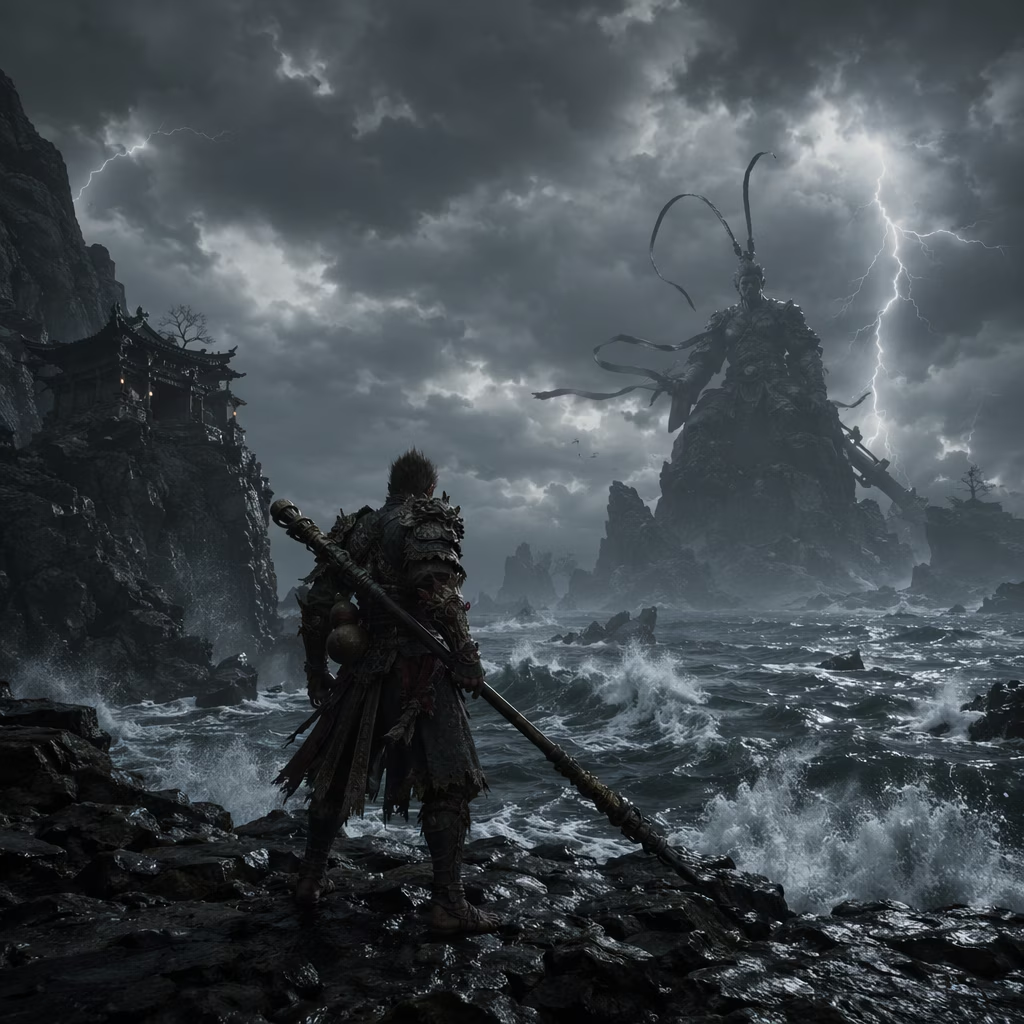
I couldn't help but chuckle at the irony: Cyberpunk 2077’s single‑player launch record of 1 million concurrents had stood for four years like an unshakeable pillar, resisting even Elden Ring. Now Wukong didn’t just topple it; it suplexed that pillar into the next mountain range. The steam charts that day looked like a monkey king’s boisterous party — and the rest of the world’s games were the uninvited guests nervously holding their drinks.
The player distribution, unveiled later by GameDiscoverCo, only added to the tale’s exotic flavor. A staggering 88.1% of players were from China, 3% from the US, 1.6% from Hong Kong, and 1% from Japan. I had to read that twice. Eighty‑eight percent. It was like discovering the entire audience at an international rock concert were all locals who knew the secret lyrics to an ancient epic. The game, rooted in the classic Journey to the West, effectively became a cultural homecoming more explosive than any Hollywood blockbuster. Meanwhile, the US share — a measly 3% — felt almost surreal given how much both press and western players had hyped the pre‑release trailers. This lopsided statistic was a map of where the Monkey King’s true heart lay, and it humbly reminded the rest of us that we were just visiting his temple.
Looking at the game with 2026 hindsight, the launch-day frenzy feels almost mythological itself. Yes, the online numbers eventually settled — no single‑player experience can keep people glued 24/7 like a live‑service skinner box — but those initial hours remain etched in my mind. Game Science’s 8/10 gem, as my colleague Nat described back then, chained together colossal boss fights and visuals so lush you’d swear Guanyin herself sprinkled holy water on the graphics card. The camera could be sluggish, and exploration had more invisible walls than a maze in Heaven’s court, but none of that mattered during the siege. Players were too busy hunting down the best Black Myth Wukong weapons (the pillar stance, my beloved), unlocking abilities like a true sage, and donning armor sets that turned the Destined One into a fashion‑forward warrior.
Two years later, I still see the aftershocks. The game received a massive expansion that added the Flaming Mountains and a certain monk that made even the hardest bosses whimper. The modding community exploded with costumes ranging from celestial emperors to what I can only describe as “cyberpunk monkey.” But every time a new big‑budget release tries to beat those concurrent records, I think back to August 20, 2024, and smile. The industry learned that a tale as old as the Silk Road, crafted by a relatively small Chinese studio, could turn Valve’s platform into a trampoline for a stone monkey’s greatness. Wukong didn’t just launch a game; he performed a cultural somersault that spanned continents and shattered expectations.
In a year that gave us surprise hit after surprise hit, Black Myth Wukong was the golden cicada shedding its skin right in front of a stunned global audience. And I, for one, am still pinching myself.