I’ve always been that gamer—proudly old‑school, distrustful of anything that doesn’t hum from a box under my desk. Multiplayer? Lost its charm. Esports? I’ll pass. And cloud gaming? Please, keep that streaming nonsense away from my precious locally‑rendered pixels. That was me, right up until Gamescom 2024, when a completely unassuming MacBook shattered my convictions.
There, in the chaotic bustle of the trade show floor, I saw Black Myth: Wukong running through GeForce Now. Not on a beefy desktop, not on a console—on a MacBook. The same game that had even our own reviewer’s RTX 4090 sweating. And yet, here it was at a locked 80+ fps, every setting cranked up, with a latency so low that the overlay flickered between 3 and 4 milliseconds. I watched it for several minutes, jaw slowly unclenching, as Nvidia’s staff casually pointed to a live data readout: 50–70 Mbps average bandwidth consumption, virtually no spikes, and a picture‑perfect ultrawide presentation. The whole experience was absurdly, almost offensively, seamless.
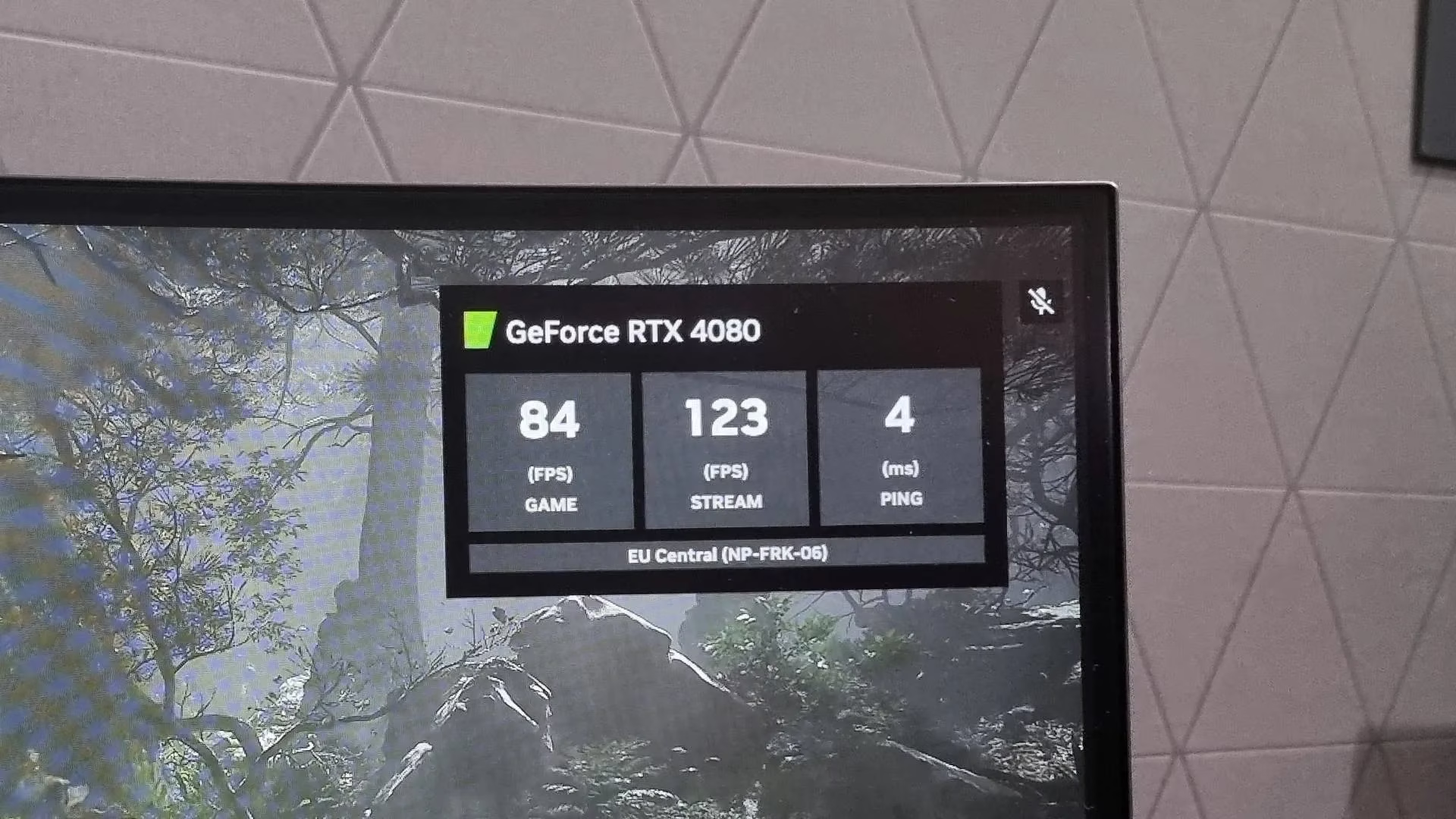
And I couldn’t help but compare it to my own setup back home. Sure, my RX 7800 XT is no slouch, but I’d still spend the first session fiddling with shadow quality, volumetric clouds, and DLSS presets, constantly glancing at the frame counter instead of soaking in the mythical world. At the booth, none of that happened. Just log in and press play. Can you imagine simply enjoying a game without playing armchair system administrator? I certainly couldn’t, until that moment.
This demonstration wasn’t running on some magical impossible connection either—it was on notoriously fickle trade‑show Wi‑Fi. The Ultimate tier I was using costs $20 a month and grants access to RTX 4080‑class grunt straight from Nvidia’s server farm. For the price of a couple of takeaway coffees, I could have every new, punishingly demanding title run like a dream no matter what device I was on. Suddenly, the multi‑thousand‑dollar GPU cycle felt, well, a little absurd.
Don’t get me wrong: I still love hardware. I love the ritual of building a PC, the smell of fresh thermal paste, the satisfaction of a perfectly routed cable. But what I witnessed was so convenient, so friction‑free, that it made me ask the uncomfortable questions. Why am I hoarding powerful silicon that depreciates faster than a sports car, when the same performance can be rented by the hour? Why wrestle with settings when someone else’s server farm does the heavy lifting? Isn’t the whole point of gaming to lose yourself in the experience, not to fret about whether your 1% lows are acceptable?
Of course, the cloud isn’t a fairy tale. A reliable high‑speed connection is non‑negotiable—my hotel Wi‑Fi back in the UK would scoff at the attempt. Then there are the business realities: providers can hike prices tomorrow, revoke your favourite hardware tier, or—like Google Stadia did—simply vanish, taking your library with them. If your internet drops, you’re staring at a blank screen, not a menu. Those are genuine trade‑offs that keep the romantic notion of local gaming firmly alive.
Yet, by 2026, the landscape has only sharpened the argument. At this year’s Computex, the conversation visibly shifted: PC gaming tech isn’t just about the biggest, hottest graphics card anymore. Nvidia’s RTX Spark laptops are promising near‑5070 performance in a thin‑and‑light form factor, and even native ARM builds of Alan Wake 2 are now a thing. But alongside these hardware leaps, cloud services have quietly matured. The latency numbers have shrunk, the stream quality has tightened, and the server‑grade GPUs behind the scenes would make my 2024 rig blush.

So here I am, a self‑confessed hardware zealot, now genuinely weighing the pros and cons. There’s a certain romance in owning your machine, in knowing that every frame is generated right there, just inches away. But when a laptop can deliver a flawless, maxed‑out Black Myth: Wukong with a few clicks, that romance starts to look a lot like stubbornness. Cloud streaming might never fully replace the local beast for the purist, but it’s become a mirror that forces us to ask: are we buying hardware for the love of gaming, or for the love of the hardware itself? And if the answer is the former, then maybe it’s time to let the cloud do the work while we get back to what we truly love—playing the game.