It is a truth universally acknowledged among PC gaming enthusiasts that some titles do not merely launch—they linger. They settle into the collective memory like a half-remembered nightmare, their audacity and emotional heft refusing to fade. Two years after its release, Senua’s Saga: Hellblade 2 remains one of those rare artifacts. Arriving in 2024 as a flagship for real-time cinematic storytelling, the game was both a torchbearer for Ninja Theory’s uncompromising vision and a lightning rod for debates about what constitutes a "game" in the first place. Now, in 2026, with the industry awash in procedurally generated open worlds and live-service perpetuity, looking back at Hellblade 2 feels less like nostalgia and more like staring into a mirror that still reflects truths we would rather forget.
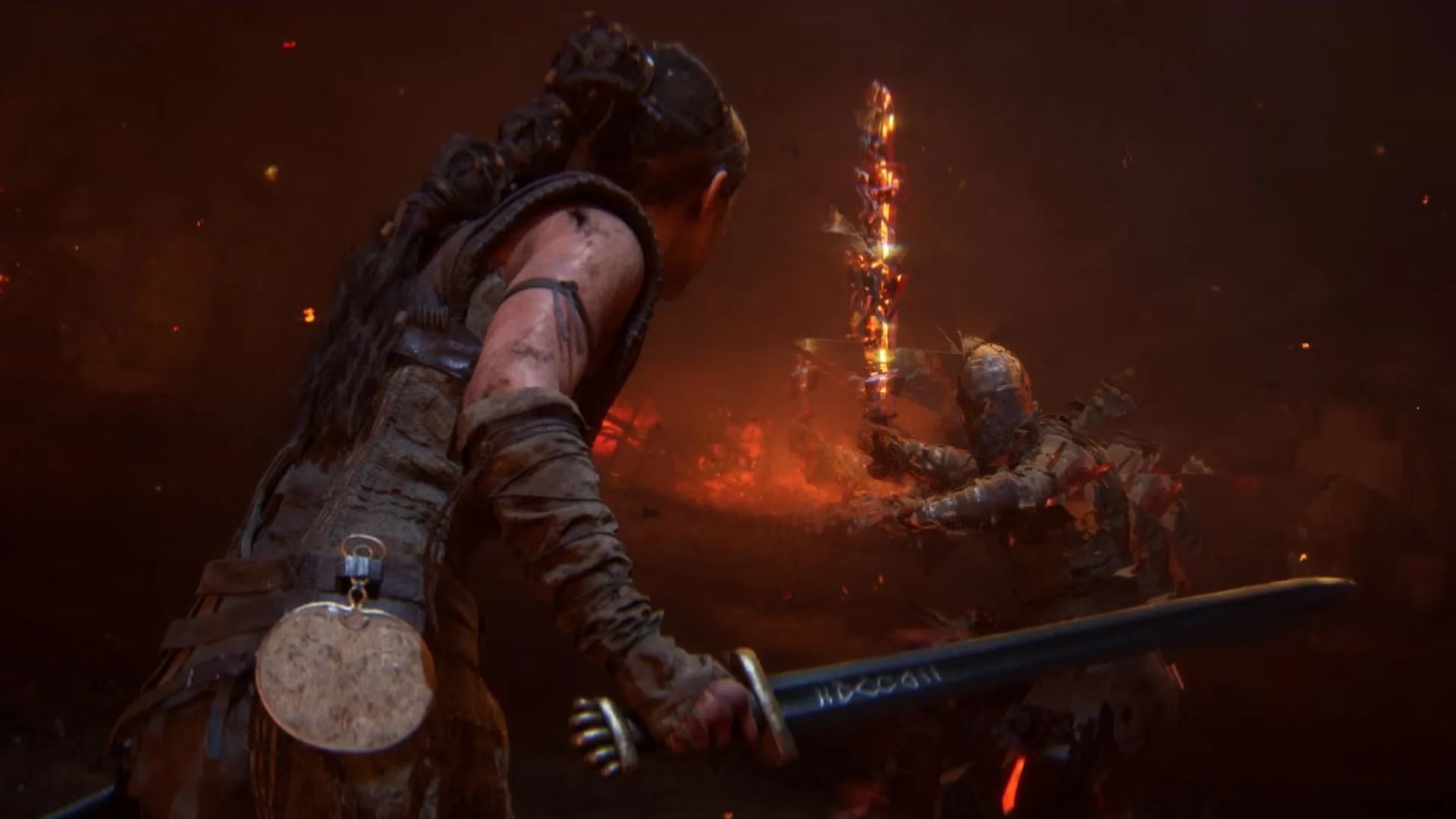
When it launched, the sequel drew ire from a vocal minority expecting a bloated action epic. They wanted side quests, skill trees, a map littered with icons like confetti after a parade. What they received was a blade-sharp linear experience: an intimate, twelve-hour plunge through Iceland’s mythic heart of darkness. That choice, to prune the experience into something resembling a carved obsidian talisman rather than a sprawling tapestry, was its greatest strength. The narrative followed Senua as she stepped beyond the inner hellscapes of the first game and into a physical world twisted by vengeance and grief. Her mission was not just a blood campaign against marauding slavers; it was a rescue operation, a reaching outward that forced her—and the player—to confront how trauma ripples through communities. This externalization of her struggle acted as a counterweight to the first game’s claustrophobic introspection, a structural decision that transformed the story from a solo aria into a choral lament.
The technical achievements still feel preternatural. The Unreal Engine 5-powered visuals in 2024 were hailed as generation-defining, but revisiting them on a 2026 rig reveals layers of detail that early hardware could only partially render. Rainwater doesn’t merely bead on skin; it traces the topography of scars with microfluidic precision. Battlefield mud churns with granular physics that sell every stumble. It is a world where the environment acts as Senua’s secondary nervous system, the landscape itself a metaphor for her psychological state—glacial crevasses yawn like rupturing sanity, while basalt columns stand as the rigid, oppressive structures of her guilt. At the core, Melina Juergens delivered a performance that redefined the uncanny valley, not by escaping it but by mining it for profound empathy. Her Senua is a creature of continuous micro-expressions, a face that registers every whisper of the Furies like a seismograph charting earthquakes of emotion. To watch her is to see an actor dismantle the wall between presence and representation.
Combat, often criticized for its simplicity, was arguably the game’s most misunderstood mechanic. It was not a combat system in the traditional sense; it was a dueling clinic conducted in a crucible of dread. Each encounter telescoped into a one-on-one death ballet, the camera clinging so close that parries felt less like button presses and more like hypervigilant reflexes. The clang of steel against steel resonated not as power fantasy but as desperate survival, every blow a punctuation mark in a sentence that could end with a period of final blackout. Ninja Theory weaponized the lack of UI and combo meters, stripping away power-trip dopamine to leave only the raw, animalistic hum of presence. Playing it in 2026, after countless imitators have attempted similar intimacy, the original still cuts like a surgical instrument.
Perhaps the most lasting impact of Hellblade 2 is its ongoing role as a pedagogical tool. In a 2026 where digital therapeutics and narrative psychology have begun to intersect more openly, the game is routinely cited in academic conferences on mental health representation. Its depiction of psychosis—co-created with neuroscientists and lived-experience experts—extended beyond the auditory hallucinations of the first game into visual layers of fractured perception. Rock faces erode into memory, shadows coil with subtext, and the fourth wall thins to a permeable membrane. The game did not merely portray a psychotic experience; it built a haunted cathedral in which the player served as both congregant and deity. For many players in 2024, it was unsettling entertainment. For analysts in 2026, it is an interactive case study proving that empathy and AAA production can coexist without dilution.
But for all its accolades, the title’s legacy is not monolithic. A significant segment of the player base drifted away, returning to the dopamine-drip loops of seasonal passes and battle royale rankings. This divergence cemented Hellblade 2’s identity as a cultural comet—blazing, unforgettable, but ultimately passing beyond the orbit of mainstream retention. Its existence challenged the metric-driven industry to ask whether a game must be "replayable" to be essential, a question that remains provocatively unanswered in 2026.
Two years on, Senua’s Saga: Hellblade 2 remains a stone dropped into still water, its ripples visible in the narrative ambitions of titles like Midnight Protocol and the audio design of Echoes of the Void. Loading it up today, the sensation is less of revisiting a game and more of submitting to an exorcism. It reminds us that in an era when our libraries swell with content, the experiences that truly count are those that, like a searing brand, mark us permanently. And in the quiet moments after the credits roll, when the silence of the speakers returns, we realize that some voices—Senua’s among them—will never truly stop speaking.