I still remember the first time I booted up Black Myth: Wukong on my beast of a rig. It was mid-August 2024, and I had been counting down the days like a kid waiting for Christmas. When the main menu faded in and that opening forest hit my screen, I kid you not, I just sat there with my jaw on the floor. The water reflections, the way light filtered through the canopy, the soft shadows under every pebble and leaf—it was next-level. Game Science had been hyping the PC version's Full Ray Tracing and DLSS 3.5 with Ray Reconstruction, but seeing it in motion? Holy moly.
First Impressions: Entering the Myth
Story-wise, I have always been a huge fan of Journey to the West, so stepping into the Destined One's shoes was already a treat. But from a pure gamer perspective, the technical showcase was the real hook. Right off the bat, I maxed out everything on my RTX 4090 and flipped on Full Ray Tracing. The opening area—dense bamboo groves, shallow streams, and misty ridges—became a living painting. I spent a good ten minutes just walking through water to watch reflections warp and shimmer with every step. That is the kind of stuff that makes you call your buddies over.
Ray Reconstruction and Path Tracing: A Technical Deep Dive
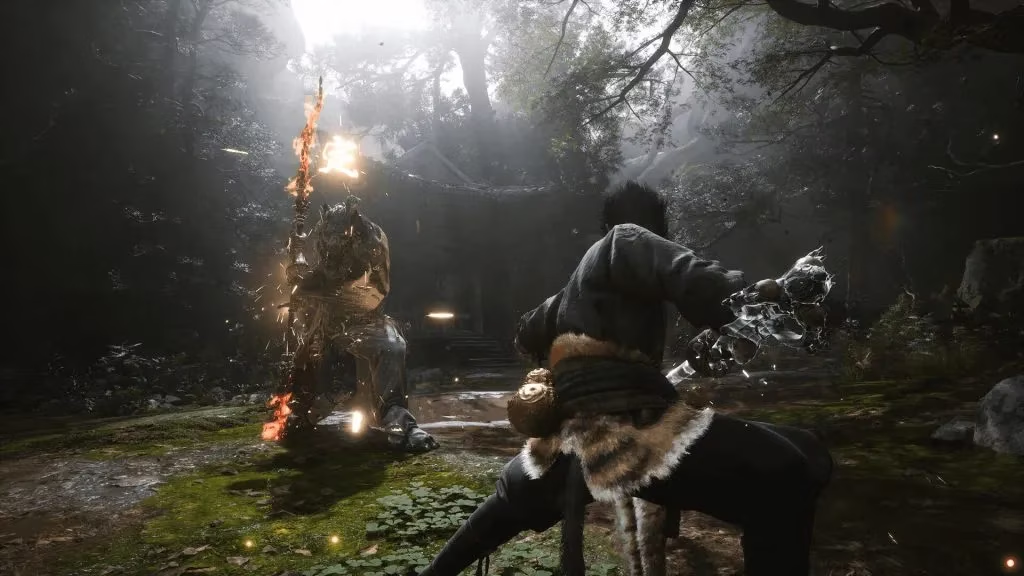
Let me break down why this matters. Black Myth: Wukong shipped with two heavy-hitting Nvidia features: DLSS 3.5 with Ray Reconstruction and Full Ray Tracing, also known as path tracing. Instead of faking light with screen-space tricks, path tracing simulates the actual behavior of light rays. Reflections in ponds mirror the entire environment—trees, cliffs, enemies, even the monkey's fur. Water caustics add that extra layer of realism, bending and refracting light like the real deal. Fully ray-traced global illumination means indoor caves and outdoor ruins are lit pixel-perfectly, with light bouncing naturally and shadows creeping into every corner where light can't reach.
Ray Reconstruction is the unsung hero here. Traditional denoisers can smear fine details, but DLSS 3.5's AI-based denoiser keeps those rich textures and sharp edges while cleaning up the noisy path-traced image. In practice, that meant my game looked crisp, stable, and buttery smooth—no flickering, no weird halos around the Monkey King's staff.
Performance Check: No Pain, All Gain
Let's be real, path tracing is tough on GPUs. But DLSS 3.5 with Frame Generation saved my bacon. On my 4090 at 4K with everything maxed, I hovered around 90-110 FPS in most areas. Boss arenas with heavy particle effects dipped a bit, but never below a comfortable 70. On a 4070 Ti, I would recommend 1440p with DLSS Quality and Frame Generation on—it is the sweet spot for stable 60+ FPS while keeping those rays flowing.
Here is a quick look at what I used for my playthrough:
| Setting | Recommendation |
|---|---|
| Resolution | 4K (RTX 4090) / 1440p (RTX 4070 Ti) |
| DLSS | Quality + Frame Generation |
| Ray Reconstruction | On |
| Full Ray Tracing | On |
| Textures | Very High |
| Shadows | Fully Ray Traced |
| Global Illumination | Path Traced |
Boss Fights: Where Full Ray Tracing Shines
No joke, the big boss arenas are where this tech truly flexes. Take the wandering giant with the massive club—when the sun sets and the arena is lit by those orange embers, every crack in the stone, every strand of fur, and every particle of dust casts its own shadow. Contact hardening shadows make close-up details look razor sharp, while distant shadows soften naturally. It is the kind of visual depth that makes dodging and parrying feel even more intense because you can read the enemy's movement against a realistic backdrop.
My Favorite Visual Moments
-
🌊 Wading through the Green River at dawn: water caustics sparkling like liquid diamonds.
-
🏯 Exploring the ruined temple: interior light bouncing off burnt wood, creating deep, moody shadows.
-
🍂 The Golden Wind Mountain pass: thousands of falling leaves each casting tiny moving shadows.
-
⚔️ The final clash with the spear-wielding boss: path-traced reflections on the wet stone floor beneath our feet.
By 2026: More Than a Launch Day Gimmick
Fast forward to now, and Black Myth: Wukong has only gotten better. Post-launch patches refined the Full Ray Tracing implementation and added support for newer DLSS features, so even if you are on an RTX 50-series card in 2026, you will get multi-frame generation and even smoother performance. Community mods have also pushed the tech further, letting tinkerers adjust light bounces and shadow resolution. But the foundation Game Science laid back in 2024 remains as solid as a rock—pun intended.
Final Thoughts
If you are still sleeping on Black Myth: Wukong's ray tracing, I don't know what to tell you. It is the kind of game you show off to people who don't even play games, just to watch their eyes bulge. The combination of path tracing and DLSS 3.5 was a one-two punch that set a new benchmark for action RPGs. As a professional gamer, I care about frame rates and responsiveness first, but when a game looks this good while staying this smooth, it is a win-win. Do yourself a favor: turn on Full Ray Tracing, crank up DLSS, and let the Monkey King's world knock your socks off.