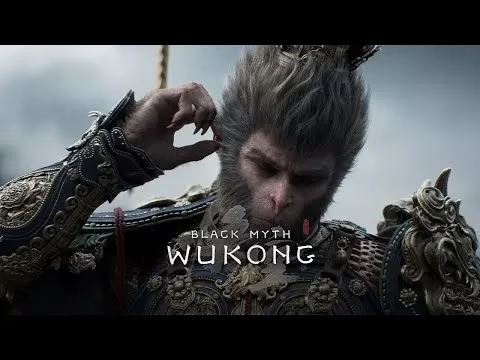
I still remember the week Black Myth: Wukong finally launched on PlayStation 5 and PC back on August 20, 2024. It was supposed to be a celebratory moment for Chinese game development — a stunning action RPG inspired by Journey to the West that had captured global attention for years. But instead of just talking about combat, bosses, and performance, a chunk of the conversation shifted toward a leaked document. That document, sent by the marketing team at co-publisher Hero Games to influencers and streamers, asked them to avoid certain topics in their coverage. Looking back from 2026, it is still one of the most revealing moments in the game's launch cycle.
The leak first surfaced over the launch weekend when French content creator and journalist Benoit 'ExServ' Reinier shared it on social media. Forbes reporter Paul Tassi later confirmed its validity. Eurogamer also clarified that this document was not shared with journalists for review coverage. So this was not a standard press brief. It was aimed specifically at content creators, which makes the tone and the demands feel a little different.
The document itself is split into a short list of do's and a much longer list of don'ts. The do's section is almost charming in its simplicity: 'enjoy the game.' But then you hit the don'ts, and things get complicated fast. According to the leak, influencers and streamers were told:
-
Do NOT insult other influencers or players.
-
Do NOT use any offensive language or humour.
-
Do NOT include politics, violence, nudity, feminist propaganda, fetishisation, and other content that instigates negative discourse.
-
Do NOT use trigger words such as 'quarantine' or 'isolation' or 'Covid-19'.
-
Do NOT discuss content related to China's game industry policies, opinions, news, etc.
Some of those are perfectly reasonable. Asking creators not to insult each other or players is basic community etiquette. Avoiding offensive humour is fine for a global audience. But phrases like 'feminist propaganda' and the ban on discussing China's game industry policies immediately raised eyebrows. It felt less like a standard content guideline and more like an attempt to control the narrative in a very specific way.
 .png?width=570&quality=85&format=jpg&dpr=3&auto=webp)
From my perspective as someone who has covered games for years, the inclusion of 'feminist propaganda' is the most jarring part. It is not a neutral term. It is a loaded phrase that signals a particular ideological stance. When a studio or publisher asks creators not to mention feminist propaganda, they are not just asking for focus on gameplay; they are asking people to stay silent about gender politics. That becomes especially relevant when you remember that Game Science, the developer behind Black Myth: Wukong, had already faced reports of misogyny at the studio. Back in 2020, posts from Game Science CEO Feng Ji containing sexualised and misogynistic language were reported on. IGN also covered the studio's history with sexism. So when the marketing team asks influencers to avoid feminist propaganda, it is hard not to connect the dots.
The Covid-19 related don'ts are also strange. Why would a fantasy action game about a monkey king need a ban on words like 'quarantine' or 'isolation'? Probably because they did not want any discussion drifting toward lockdowns or pandemic-related controversies in China. It is an oddly specific rule for a game that has absolutely nothing to do with viruses or public health. It suggests a high level of caution, maybe even fear, about how Western audiences might interpret the game or its country of origin.
Then there is the rule about China's game industry policies. This one is even more directly political. It effectively tells creators: do not talk about regulations, censorship, working conditions, or any news related to the Chinese games industry. For independent content creators, especially those in the West, that kind of instruction can feel like a red flag. It turns a simple sponsored or early access opportunity into a space where certain conversations are off limits by default.
I have seen plenty of influencer guidelines in my time. Most of them say things like 'do not spoil the story after chapter three' or 'please disclose that this is a sponsored video.' They rarely dip into politics this bluntly. The closest I have experienced was during my own preview session with Game Science, when I was told the studio 'will only answer questions related to gameplay.' At the time I thought it was just a developer being protective of an unreleased game. In hindsight, it fits a broader pattern of tight information control.
It is also worth noting that Black Myth: Wukong was the first major console release from this Chinese developer. The massive global attention was new territory for them. Some people argued that the leaked document simply showed inexperience when dealing with Western media and influencers. That is possible. But the specific wording around feminism, Covid-19, and China's game industry policies goes beyond clumsy phrasing. It reads like a deliberate attempt to steer coverage away from anything that might trigger negative discourse.
Now in 2026, Black Myth: Wukong has cemented itself as a landmark release. It broke sales records, sparked endless debates about its difficulty, and helped push more eyes toward Chinese game development. The document, though, remains an important reminder of how marketing and politics can collide even when everyone involved says they just want to focus on the game. As a player, I can absolutely understand wanting the conversation to stay on combat, level design, and boss fights. As a creator, I also know that trust depends on transparency. When a publisher hands you a list telling you what words you cannot say, that trust starts to crack.
For me, the lesson from that 2024 launch is not that Game Science is uniquely bad. Many companies try to manage messaging. But there is a difference between asking creators to be respectful and asking them to erase entire topics from the conversation. One is community management. The other is narrative control. Two years later, I still think about that difference whenever I see a new marketing email land in my inbox. And honestly, that might be the healthiest reaction of all.