To answer the questionIs Black Myth: Wukong open world?: No, it is not. Although Game Science's title sold over 25000000 copies before the new year began; it is less expansive when compared to an open-world or sandbox-style RPG than it may seem from preliminary glimpses.
Rather than being one giant roaming location, Black Myth: Wukong is an altruistic action/adventure role-playing game based on Journey to the West; providing players with semi-expanded areas of travel that seem vast, but are in actuality tightly controlled.
Understanding the difference between these two types of gameplay is extremely important; as it shapes what you're going to get as a player for the purchase of the game.
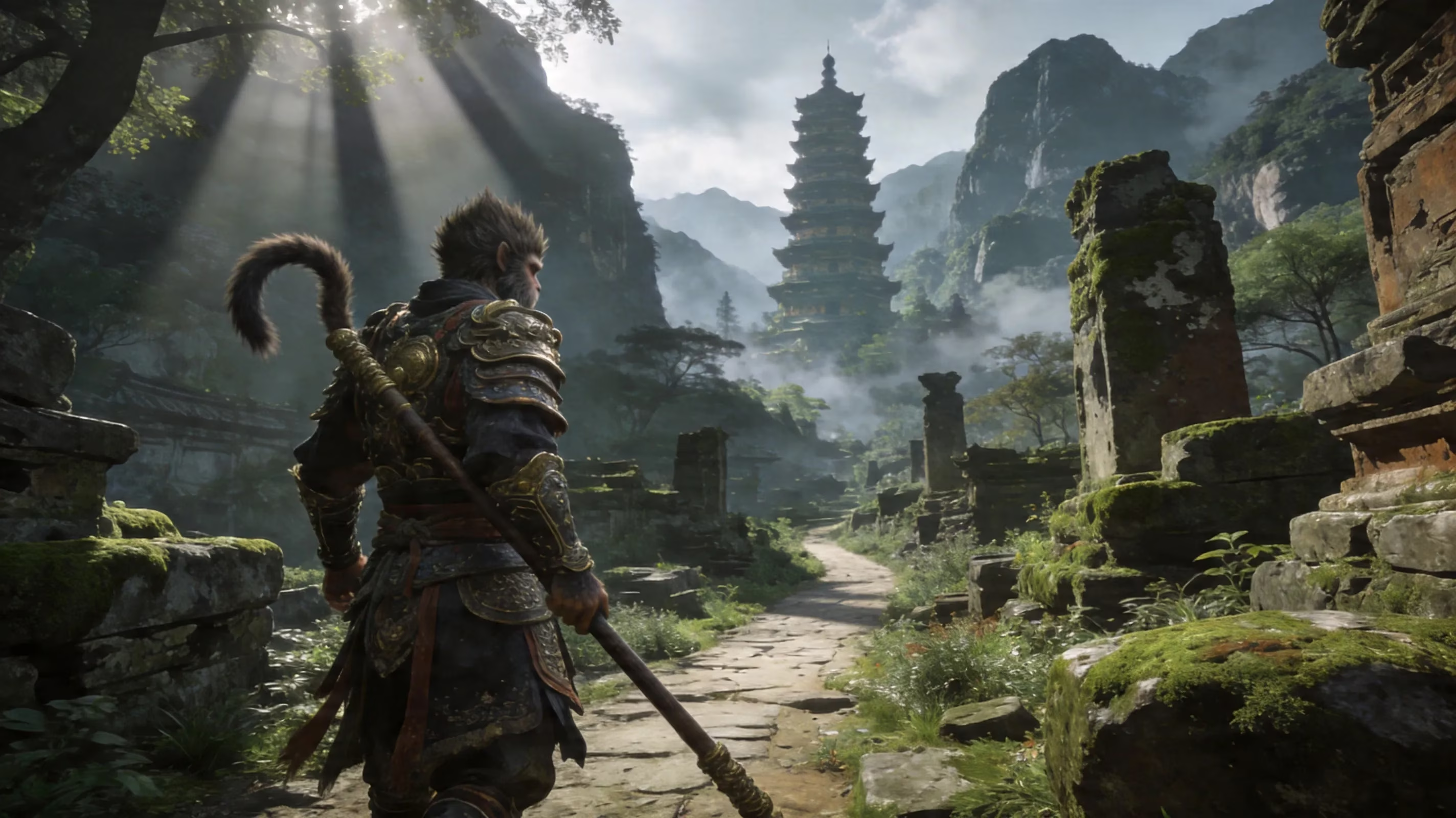
Is Black Myth: Wukong an Open World Game or Linear Game?
Black Myth: Wukong is not an open-world game, in the strictest sense. A more appropriate description of Black Myth: Wukong is a semi-linear action role-playing game with a chapter progression structure; consisting of a total of 6 chapters:
Chapter One: Black Wind Mountain
Chapter Two: Yellow Wind Ridge
Chapter Three: Flaming Mountains
Chapter Four: Webbed Hollow
Chapter Five: Bitter Lake
Chapter Six: ?? (Final Chapter - Gameplay not yet available)
Each chapter contains branching paths of exploration that players will go through. Thus, no traditional 'overworld map' ** exists that can tie different areas together. Once entering a chapter, players will navigate and explore various route structures (hopefully branching in nature) and combat zones (containing Black Myth: Wukong) through the boss battles provided within the story progression structure. All progression in and through any given chapter will occur in a one-way flow of travel, and while there may be some paths allowing for re-travel back under certain conditions; at no time will a player be able to freely move back and forth through the entirety of Black Myth: Wukong through the overworld map as in true open-world style games. This is exactly why the "Is Black Myth: Wukong open world?" keeps being inquired; there seems to be a great deal of confusion among users trying to determine the type of RPG provided. While it can seem like certain areas of the game are quite expansive and full of potential exploration opportunities, especially early on when you're still figuring out how everything fits together, in reality, you've been guided down a fixed progression path. In this regard, Black Myth: Wukong feels much more similar to Sekiro: Shadows Die Twice than Elden Ring.
World Design in Black Myth: Wukong
Each level is designed with a series of interconnected paths and side paths, rather than being actual open-world games. During your adventure, you will also spend a considerable amount of time at Keeper's Shrines, which serve as checkpoints, respawn points, and upgrade locations. These shrines provide the backbone for the navigation system; as such you will quickly begin to memorize these as a result of the numerous failed attempts at boss battles and the amount of time spent traveling between shrine and arena.
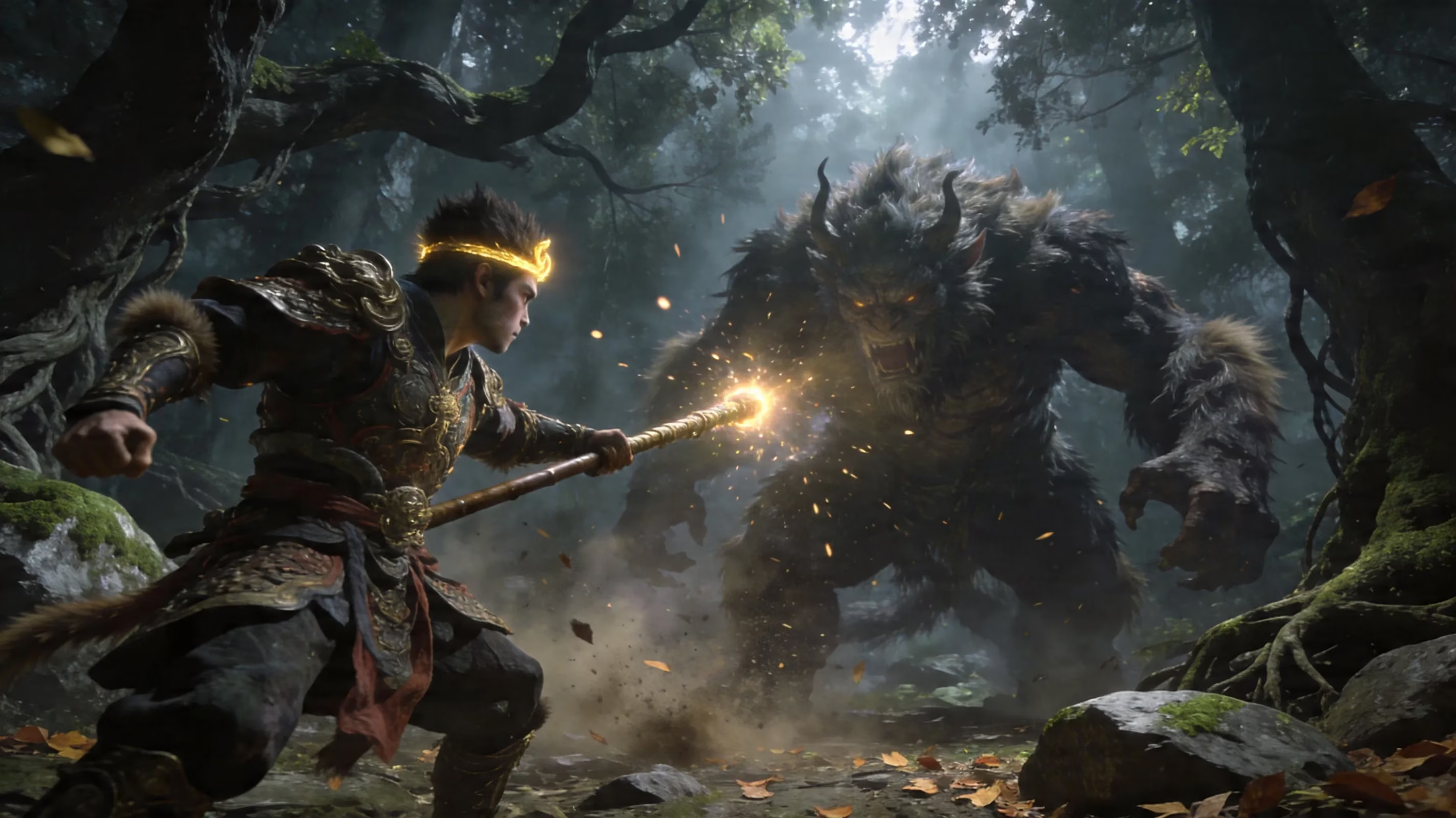
There are significant rewards for exploration, as you will find hidden bosses, hidden combat arenas, and hidden side paths. Some of the best rewards that you will find will be achieved by observing that something is off within your environment. For example, if there is a ledge that appears somewhat odd, or you see a tunnel that is not necessarily marked, or a wall that appears it can be broken through; all of these items can lead you to an optional Yaoguai Chief fight and reward you with a unique Spirit transformation that is not available unless you go through the normal route.
Having stated all of that, the greatest problem with the game is that Black Myth: Wukong is heavily reliant on the use of invisible walls or hard barriers that restrict movement. You will regularly come across slopes, ledges, or open terrain that you attempt to scale only to be met with failure when you come to realize that your attempts to do so were never supposed to happen. So while the actual environment may appear quite large, traverse-ably speaking; the amount of space available for you to traverse through is considerably smaller than it seems. ## How Does Exploration Feel in Black Myth: Wukong
Exploration in Wukong has two layers of exploration.
-
Main Path: Story scenes, mandatory encounters, and boss fights that are required in order to advance.
-
Detours: Optional loot, Spirits, crafting materials, mini-bosses, and NPCs who offer questlines.
This two-prong approach works well for players who want a specific path to follow, with some optional content along the way. You will typically be progressing toward the next big fight, yet if you venture down the side road, you will discover new things and feel rewarded for your curiosity. "Side" content can provide benefits to your character and can sometimes expand your character's available tools.
Once you revisit an area you may have previously explored, the value of doing so may change based on the chapter. Areas that are earlier in the game, such as Black Wind Mountain, will often reward you more for backtracking than later chapters once you gain higher-level abilities that allow you to access previously inaccessible areas of exploration. As newer chapters generally have a more defined beginning and ending to them, backtracking to these areas will tend to feel more like a clean-up exercise for players focused on completing the game rather than a means of experiencing new discoveries in those areas.
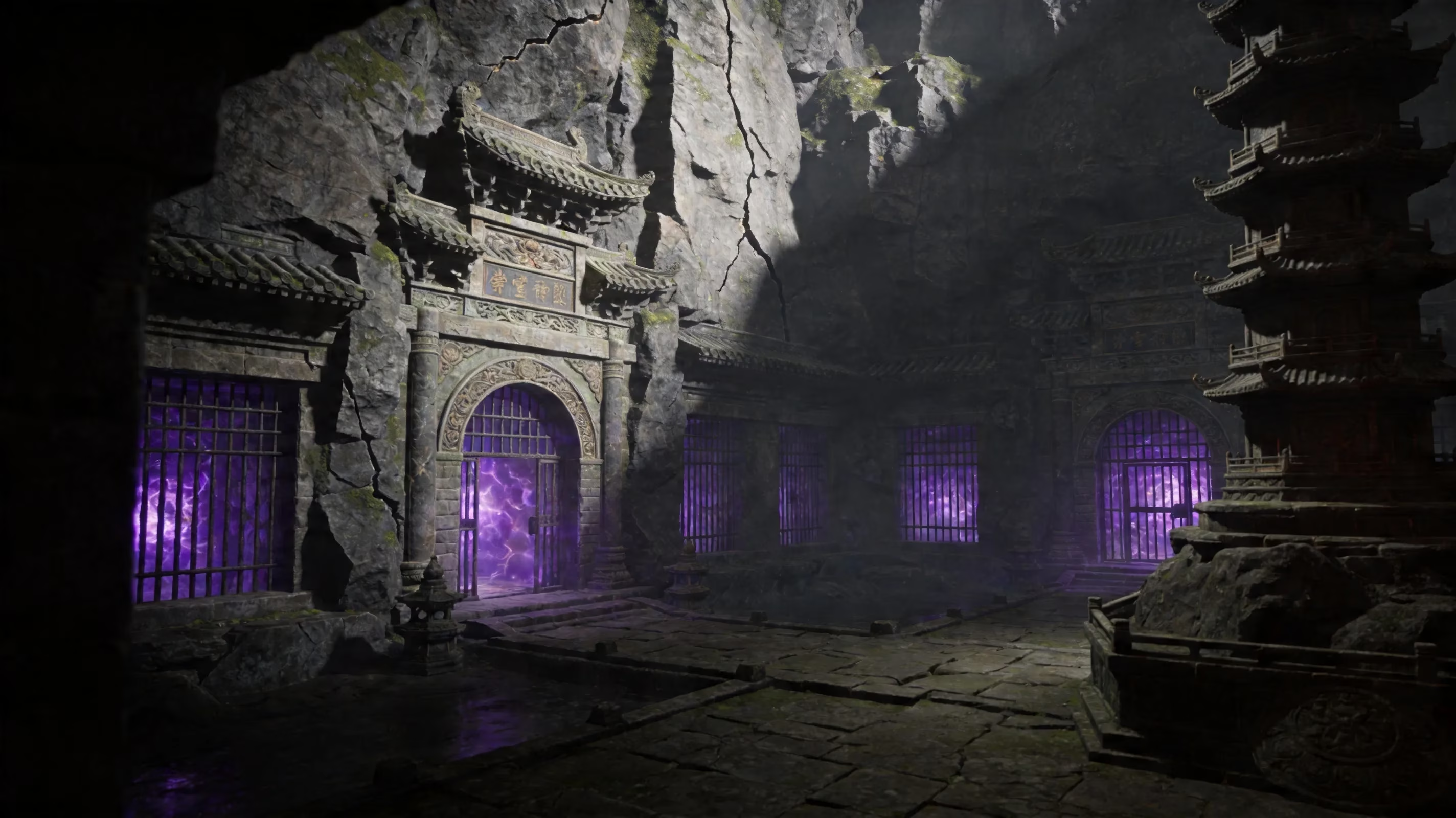
An excellent case in point is the Pagoda Realm, located in Chapter Three. While exploring the Pagoda, you will encounter purple barriers blocking the entrances to many cells containing prisoners of the Captain Lotus-Vision boss. No matter what means you utilize—i.e. items, spells, traversal tricks—none will allow you to open these barriers until after you have defeated the Captain Lotus-Vision boss. Once you have completed this boss, the barriers will no longer be in place, and the cells can be accessed. However, until the Captain Lotus-Vision has been defeated, all of the cells will remain inaccessible to you, even if you thoroughly search the area. They have a synchronized opening mechanism, allowing players to quickly access side quests and extra treasure chests without backtracking significantly. It serves as a clear demonstration of how exploration works in Black Myth: Wukong—where you will not be able to discover freely; it will instead be based on progression, determined by boss encounters and narrative chapters.
If players take their time to explore and participate in side content and optional boss encounters, then the total playtime for the game will be about 40-50 hours. Players who are only focused on the main quest may miss out on a lot of game content. However, there is only limited exploration in Black Myth's world with no true open world.
Black Myth: Wukong compared to True Open World Games
When you compare Black Myth: Wukong to other true-open world games, the difference becomes more obvious.
Game | World Structure | Total Navigation Freedom | Backtracking (Return) | Boss Pacing
-|-
Black Myth: Wukong | Chapter-based Zones | Low (Chapter-gated) - Low | Medium (Zonal) | High; Boss Rush Mechanic
Elden Ring | Interconnected Open World | Very High (All available immediately) | Very High (Global Fast-Travel) | Very Low; Spread Throughout Map
Sekiro: Shadows Die Twice | Hub-connected Linear Zones | Medium (Once Shortcuts are opened) | Medium (Same Zone) | High; Concentrated/ Story Gated
God of War (2018) | Semi-Linear w/HUB Lake | Medium (Using Boat) | High (As You Learn New Abilities) | Low; Spread Throughout Regions
The game that most contrasts with Wukong is Elden Ring. In this game, players can ride to the horizon and discover forgotten content simply by exploring. Players may also explore areas out of order or use global fast travel to revisit areas at any time. Black Myth: Wukong does not allow players to jump from Chapter 2 to Chapter 5 or enter end-game areas simply because they are interesting.
Sekiro is a better comparison; both games utilize shrine-like checkpoints and have compact zones, but Sekiro feels simpler and more understandable due to fewer false paths and hidden barriers.
God of War (2018) is also in the semi-linear category and has linear progression through the story while having free-roaming exploration through hubs; the Lake of Nine gives players a clear sense of revisiting the same area and branching out. Wukong lacks anything like that in terms of centrality, so the game often feels even more linear during normal play.
Pacing also differs; with Wukong featuring over 80 bosses/mini-bosses, there are times when the game feels like it has a very high boss-rush pace. In open-world RPGs, travel between landmarks is typically as important as fighting the actual bosses themselves. In Wukong, the combat encounters themselves take center stage; all the spaces around them exist primarily to support this loop of gameplay. ## Black Myth: Wukong World Structure Player Preferences
Based on the feedback we have received from the Black Myth: Wukong (BM:W) world structure, players will either strongly enjoy this game or be completely turned off by it.
It seems to me that players who like the BM:W world structure the most would be those who have:
-
A preference for a strong narrative momentum versus complete freedom to explore.
-
A desire for combat and bosses to be the focus of the experience.
-
An interest in mastering a predetermined challenge.
-
A belief that most open world games are overly cluttered or unfocused.
-
An affinity for games in the same vein as Sekiro or Devil May Cry 5.
The BM:W world design caters to these players by maintaining a constant level of pressure, reducing wandering, and concentrating the game's strengths around boss battles, build experimentation, and spectacular combat using mythological elements.
On the other hand, players who are likely to be disappointed with the BM:W world structure will have either:
-
Been expecting a structural resemblance to Elden Ring
-
Primarily play sandbox RPGs for free-form exploration
-
Enjoy wandering without an endpoint
-
Hatred of invisible walls, and strict area barriers/limitations.
The divide appears to be based on what you consider to be the most enjoyable aspect of gaming. If you enjoy being able to get lost and experiencing un-scripted moments on your terms, then you will likely feel restricted by the BM:W world structure.
Players are expected to complete the main story in about 25-30 hour game, while players who choose to pursue optional bosses, hidden Spirits, and side quests can take approximately 40-50 hours to complete the game. The location of Black Myth: Wukong is interesting in that compared to what you would think of as a traditional linear action game, Wukong will run longer and yet it is actually going to be shorter than these same types of games. So, while some people may perceive it to just be an open world RPG, I think we can compare it a little closer to these longer linear action RPGs.
Platform would have little effect on the actual game-play (chapter format). The chapter format remains consistent on all platforms (PC, PlayStation 5 and Xbox Series S/X). So it's really just about performance, graphics and a small issue with DualSense haptics on the PS5; not about different design worlds.
Black Myth: Wukong FAQ
Is Black Myth: Wukong an open-world game?
The answer is no; Black Myth: Wukong is not an open-world game. The more accurate description therefore would be a semi-linear, chapter-based action RPG with an Souls-like format. Each chapter contains a separate yet contained area of gameplay with the ability for you to choose to progress along multiple route paths as well as find optional content and save points (Keeper Shrines); however, you can still finish each chapter only in linear order. If you want something similar to Black Myth: Wukong, think of a game like Sekiro: Shadows Die Twice; not Elen Ring or Zelda: Breath of the Wild.
Does Black Myth: Wukong have a map?
No, there was no in-game map for Black Myth: Wukong. You will get familiarized with the layout of each chapter using the environment as reference points, using long-term memory to reference shrine locations, and, by playing each chapter many times to slowly memorize layout or the path; but the game developers clearly built this to purposely not allow players any in-game map, and this policy caused some of the most negative feedback towards the game, particularly in the denser chapters where it's much harder to successfully do this.
As a result of this, many players then chose to utilize community tools, such as user-created maps that became available through Reddit and many gaming wiki sites. Many players became dependent on these many different community assets to assist with their navigation of the game. Game Science has yet to develop an in-game map for use in Black Myth: Wukong or through post-release patches (as of early 2026).
Will players be able to freely explore all chapters within Black Myth: Wukong?
To a limited extent, players will have the ability to freely explore some areas of all of the different chapters contained within the world of Black Myth: Wukong. There are two primary limitations to the player's ability to freely explore when they are playing any chapter in Black Myth: Wukong:
1) Chapter Lock - A chapter lock will prevent the player from accessing different areas of the chapter (such as hidden passageways) until the chapter storyline has cleared to allow you to access to those areas.
2) Internal Gates - The player will not be able to access or reach a number of different rewards, or complete different paths in the current chapter, until they defeat the appropriate boss.
As there are some instances in Black Myth: Wukong of secret floor drops, hidden paths, breakable environmental objects, and other hidden areas, there are still no areas in Black Myth: Wukong that are accessible outside of the parameters of the current chapter in which you are playing. An example of this is when playing in the Pagoda Realm cell-lock, there are certain hidden areas that you may not be able to access until you defeat that chapter's boss.
So, in short, you cannot explore freely throughout Black Myth: Wukong.
The conclusion is that while you can explore freely in certain areas of the game, compared to say, a sandbox or an open-ended journey, like you might find in Elen Ring or Zelda: Breath of the Wild, you cannot do this in Black Myth: Wukong. Rather than just through exploring, the main focus of why we think you should buy Black Myth: Wukong is due to its intense boss fights, its depth of traditional combat through three distinct styles of combat with a number of different Spirit abilities, and that it is based on the well-known Chinese myth (Journey to the West).