I still remember the exact moment I first saw Black Myth: Wukong. As a professional gamer who has spent thousands of hours dissecting combat systems, I rarely get genuinely stunned by a first reveal. Yet when the thirteen-minute gameplay demo from the Hangzhou-based studio Game Science dropped on 19th August, I watched it three times in a row, convinced I had missed something. The fluid martial arts, the jaw-dropping enemy designs, and the sheer confidence of the presentation felt like a seismic shift. Could a Chinese studio really be about to deliver the country's first true triple-A action epic? The answer, at least from that first day, seemed to be a resounding yes.
🐒 A Retelling of Journey to the West
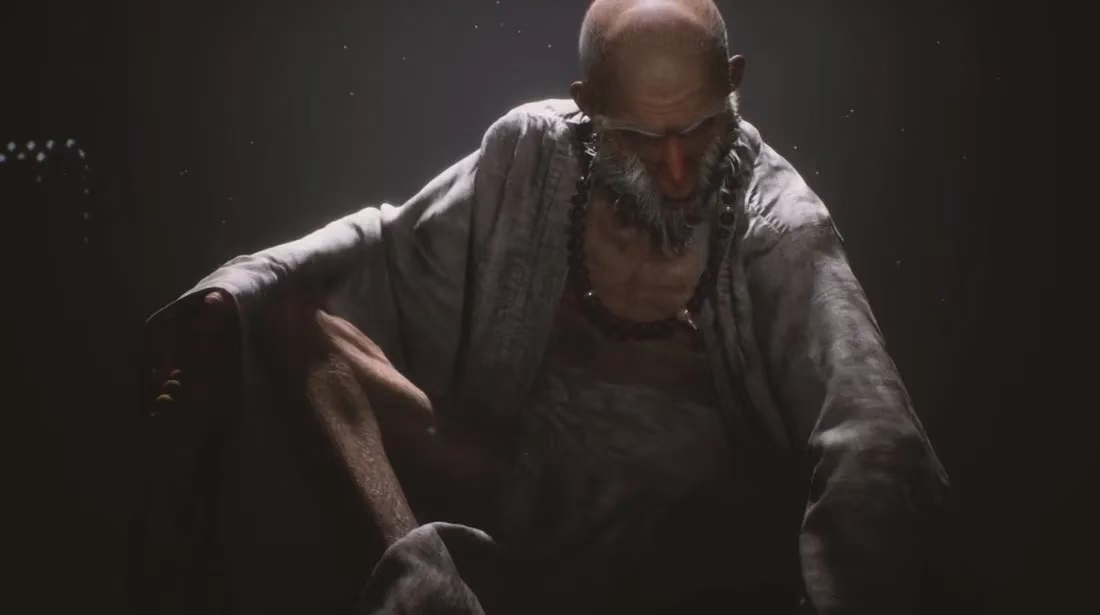
Black Myth: Wukong is not just another action game. It is a retelling of Journey to the West, one of the most beloved epics in Chinese literature. I found the premise instantly appealing because the playable character is a take on the Monkey King, a figure many western players recognise from cultural osmosis, yet rarely get to embody in a serious, premium title. The gameplay reveal showed him transforming into a variety of creatures, which immediately made me think about how rich the combat possibilities could be. Instead of a simple skill tree, the transformations felt like entire movesets layered beneath the surface. Bosses are not merely large enemies; they are wonderfully realised mythical figures with distinct silhouettes, attack rhythms, and animations. The environments, from ancient forests to decaying temples, are incredibly detailed, and the physics create a tangible sense of weight and impact.
🏗️ The Studio Behind the Hype
So, what exactly is Game Science? This question raced through the community after the trailer exploded. The studio was founded in 2014 by former Tencent Games staff, and it had already created a raft of titles, but Black Myth: Wukong represented its first attempt at what most players would consider a premium, single-player experience. I have seen many mobile-focused Chinese developers pivot to console or PC, but few have ever attempted something this ambitious. According to reports, the decision to develop a triple-A game was made in 2017 after the team realised there were already more Steam users from China than from the United States. At the time, more than one million Chinese gamers were playing Grand Theft Auto on Steam. That statistic still blows my mind. It signalled that China's premium games market was going through a real transformation, and Game Science wanted to be at the front of it.
📊 The Numbers That Broke the Internet
The internet reaction was immediate and massive. Within just one day of being uploaded, the Black Myth: Wukong gameplay demo saw around ten million views on Chinese video site Bilibili and nearly two million on YouTube. It also became a top-trending hashtag on Weibo and Douyin, China's equivalents of Twitter and TikTok respectively. Those numbers matter because they proved the appetite was not limited to one region. Western action fans like me were sharing the same clips, analysing the same frames, and asking the same question: can the final product possibly live up to this reveal? The studio was still looking for a publisher and more developers at the time, which made the hype feel even more fragile and exciting.
⚔️ Was the Hype Justified?
Fast forward to 2026, and the answer is now written into gaming history. After years of waiting, Black Myth: Wukong finally launched in August 2024, and I can honestly say it delivered on much of that early promise. The final release sharpened the stance system, expanded the transformation mechanics, and preserved the stunning visual direction that first captured everyone's attention. It went on to sell tens of millions of copies worldwide, earned multiple awards including Best Action Game, and sparked a surge of global interest in Chinese mythology and Chinese single-player development. Was every encounter perfect? No. Some bosses tested my patience, and a few areas felt tighter than the trailer suggested. But the core identity remained intact: a bold, visually spectacular action game born from a team that trusted its own cultural roots.
| Aspect | First Impression (2020) | State by 2026 |
|---|---|---|
| Visuals | Unreal Engine showcase with stunning environments | One of the most visually striking action games of its generation |
| Combat | Fluid martial arts and transformation reveal | Deep stance system and varied, demanding boss fights |
| Studio status | Seeking publisher and additional developers | Became a global phenomenon and industry benchmark |
| Audience | Viral on Bilibili, YouTube, Weibo, and Douyin | Sold tens of millions, earned international awards |
🎮 Why It Matters to Me as a Player
As a professional gamer, I have been fortunate enough to play action titles from almost every major studio on Earth. Black Myth: Wukong stands out because it forced me to reconsider what Chinese developers could achieve outside mobile gaming. The game's success is not merely about graphics or sales; it is about proving that a team with deep cultural material and technical ambition can compete on the global stage. Its origins are unforgettable: a single gameplay trailer that turned a Hangzhou studio into one of the most watched developers in the world. What began in 2020 as a viral moment became, by 2026, a landmark in the evolution of the industry. And honestly, I cannot wait to see what Game Science does next.