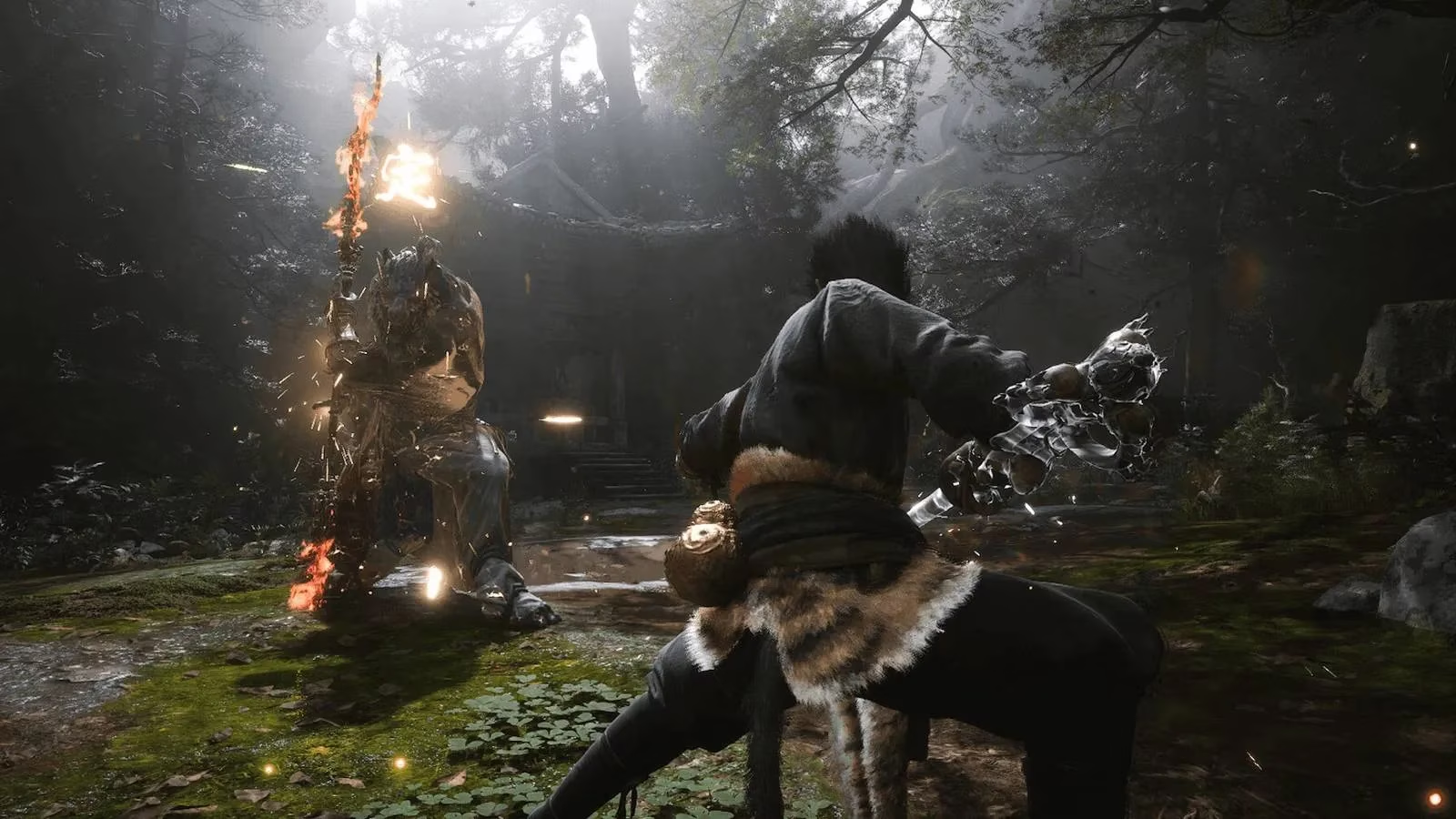
Geoff Keighley had barely finished reading the names when the internet's self-appointed statisticians went to work. In late 2024, the creator and host of The Game Awards announced the nominees for the show's tenth annual installment, and among the Game of the Year contenders stood Black Myth: Wukong. The action-adventure from Chinese studio Game Science had already become one of the year's biggest talking points, but the nomination triggered a new, narrower debate: Was it one of the lowest-rated games ever to receive the show's highest honor? 📉
The numbers, at first glance, seemed to say yes. On Metacritic, Black Myth: Wukong held an 81. On OpenCritic, it sat at 82. For a Game of the Year nominee at The Game Awards, those figures are unusually modest. The show has historically reserved its top category for critical darlings, games that cluster around the high 80s and 90s. So how low can a Game of the Year nominee go before the nomination itself becomes the story? And what does an 81 really mean in a decade-long awards conversation shaped by hype, politics, and platform wars?
Polygon double-checked the claim, scanning both score aggregators for every Game of the Year nominee since The Game Awards debuted in 2014. The publication found the observation to be mostly true. The one weird outlier was PlayerUnknown's Battlegrounds, which scored a 77 on OpenCritic despite having an 86 on Metacritic. That split is a reminder that aggregators are not monoliths. They collect different reviews, weight them differently, and rarely offer detailed public information about how or whether scores have shifted over time. Present-day numbers may not match the numbers that existed when a game was first nominated.
Even with those caveats, the pattern is clear. It is rare for The Game Awards' Game of the Year nominees to dip below the 85 mark. Other games in that range have included:
-
2014: Middle-earth: Shadow of Mordor
-
2018: Assassin's Creed Odyssey
-
2019: Control and Death Stranding
-
2020: Ghost of Tsushima
-
2021: Resident Evil Village
-
2022: Stray
None of them won the category. The lowest-rated game ever to be named Game of the Year was 2014's Dragon Age: Inquisition, which held an 85 on Metacritic and an 88 on OpenCritic. That record gives Black Myth: Wukong's nomination a strange distinction: it entered the race with a score that would have been unthinkable for a winner in most previous years. 🏆
The 2024 installment also marked the first year since 2021 in which the average Game of the Year score dropped. In 2021, every nominee scored below 90, making it the only other recent ceremony with a similarly compressed critical ceiling. In 2024, every other nominee scored 90 or above on both aggregators, which made Black Myth: Wukong's 81/82 stand out even more. It was not just a low score relative to the field; it was a low score relative to the show's own history. 🔍
But the story was never only about numbers. Black Myth: Wukong had been a centerpiece of the culture war within gaming after IGN published an investigation in November 2023 into allegations of sexism at developer Game Science. The report spoke to several women in the Chinese gaming industry about "misogynistic remarks" by men at the studio, including CEO Feng Ji. In the months that followed, discussing the game on social media became almost unbearable. Some right-wing figures took up its banner in a transparent effort to needle their perceived online enemies. The game became a proxy, a symbol, a battlefield. Was it possible to talk about its review score without talking about all of that? Not really. ⚔️
Yet when Black Myth: Wukong finally arrived on August 20, most critics found it to be a beautiful, if repetitive, action-adventure. The game's lush environments, kinetic combat, and mythological spectacle earned praise. Its pacing and structural repetition drew criticism. That mixture produced the 81/82 split that made the nomination so contentious. It was not a disaster. It was not a universal triumph. It was a strong, flawed game in a year full of stronger, more polished critical favorites.
Looking back from 2026, the 2024 Game of the Year nomination remains a useful flashpoint. It shows how The Game Awards has become more than a celebration of review scores. It is a collision of popularity, identity, commerce, and online grievance. The show's nominees are not chosen by Metacritic or OpenCritic; they are chosen by a jury of publications and influencers, and their tastes do not always align with aggregate numbers. That gap can be healthy. It can also be messy.
For Black Myth: Wukong, the nomination did not settle the debate. It intensified it. Fans saw validation. Detractors saw evidence of hype outpacing quality. Analysts saw a statistical anomaly. And the rest of the industry saw a reminder that in modern gaming, a score is never just a score. It is a weapon, a shield, and a story all at once. 🐒